

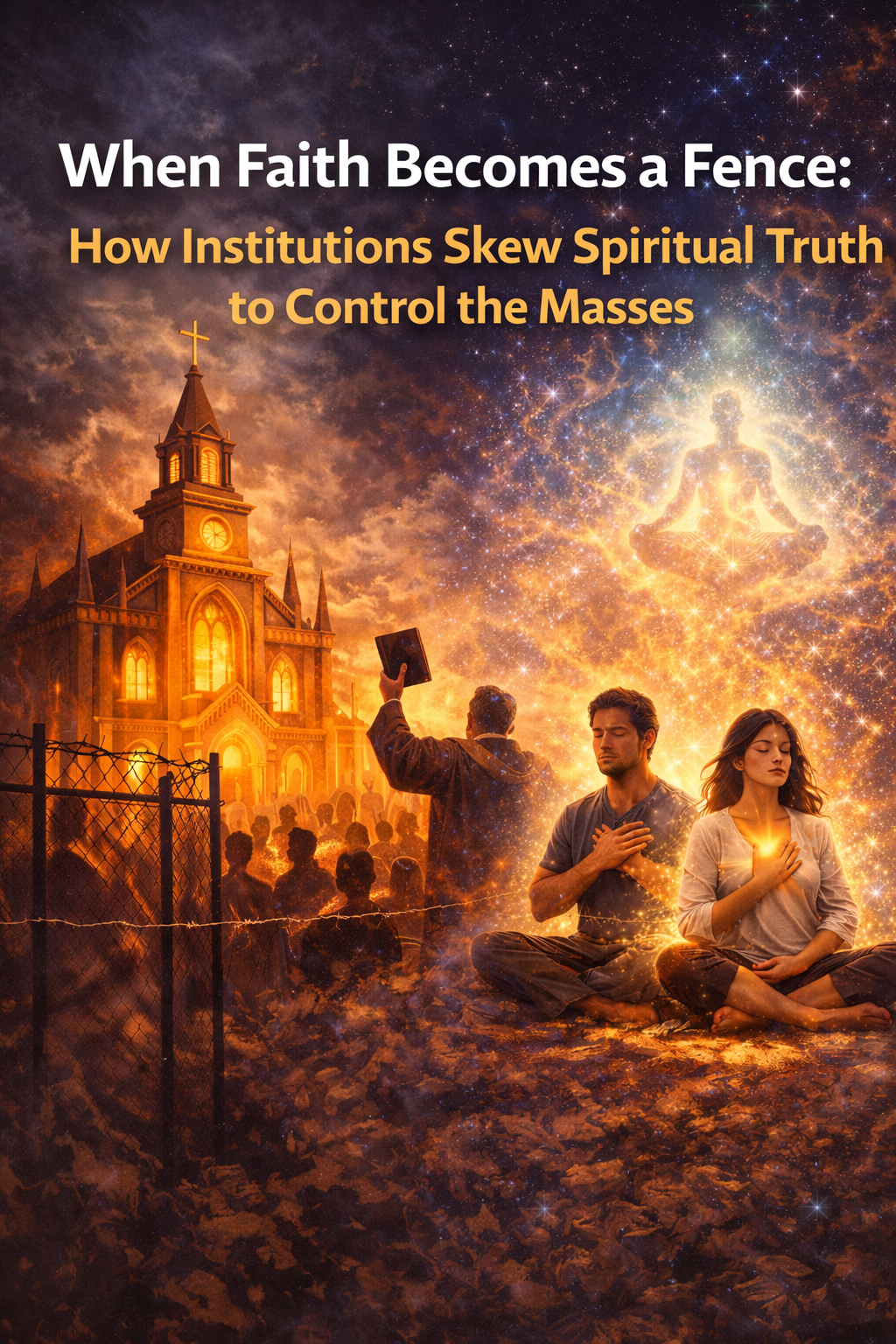
At our core, every human being is capable of pure, unconditional love. You see it in a child who shares their favorite toy without hesitation, or in the quiet warmth that comes from helping a stranger with no expectation of reward. That openness—connection, generosity, compassion—is not something we have to earn. It’s our default setting.
Yet somewhere along the way, that natural state gets buried under rules, guilt, and hierarchy.
For centuries, organized religion—particularly institutionalized Christianity—has often positioned itself not as a guide back to that inner truth, but as a gatekeeper standing in front of it.
The Shift From Inner Knowing to External Authority
One of the most profound teachings attributed to Jesus is simple and disruptive:
“The kingdom of heaven is within you.”
That statement alone dismantles the need for intermediaries, permission slips, or spiritual toll booths. If the divine resides within, then access to God is direct, personal, and immediate.
And yet, much of the modern church teaches the opposite.
God is portrayed as external. Distant. Watching. Judging. Accessed only through the “right” doctrine, the “right” building, the “right” leaders. Instead of empowerment, believers are taught dependence—on pastors, priests, institutions, and systems that claim exclusive authority over truth.
This isn’t accidental.
Control Thrives on Disconnection
When people are taught that God exists outside of them, they become easier to manage. If you believe you are fundamentally broken, sinful, or unworthy on your own, you are more likely to seek validation from an authority figure who claims to speak for God.
Fear becomes the lever:
- Fear of punishment
- Fear of being wrong
- Fear of exclusion
- Fear of eternal consequences
Control doesn’t require force when guilt will do.
Tithing, Guilt, and the Monetization of Generosity
Human beings are naturally generous. We want to give. We want to help. We want to contribute to something meaningful.
Institutional religion often exploits this instinct.
Instead of encouraging organic generosity—mutual aid, community care, direct compassion—many churches institutionalize giving through guilt-driven tithing. The message becomes clear: If you don’t give financially to this institution, you are failing God.
The result?
- Massive buildings
- Expanding staff hierarchies
- Administrative empires
All funded by people who were taught that generosity must be routed through an institution to be spiritually valid.
Giving, which should be an expression of love, becomes an obligation enforced by shame.
The Subtle Rewriting of Power
Perhaps the most damaging shift is this:
Spiritual power is reframed as something you lack.
Instead of being taught that you are a fractal of the source—an expression of the same creative, loving intelligence that animates everything—you are told you are powerless without the church.
Instead of inner discernment, you are given doctrine.
Instead of direct experience, you are given interpretation.
Instead of sovereignty, you are given submission.
Over time, people forget how to trust their own inner compass.
Faith vs. Institution
This is not an argument against spirituality.
It’s not even an argument against Jesus’ teachings.
It’s an argument against systems that twist those teachings to maintain control.
True spirituality doesn’t require a middleman.
True faith doesn’t thrive on fear.
True love doesn’t demand proof through payment.
If the kingdom of heaven is within us, then awakening is not about obedience—it’s about remembering.
Remembering who we are.
Remembering our capacity to love freely.
Remembering that connection to the divine was never something we had to earn.
It was always already there.