
Forgetting was never a mistake.
It was the agreement.
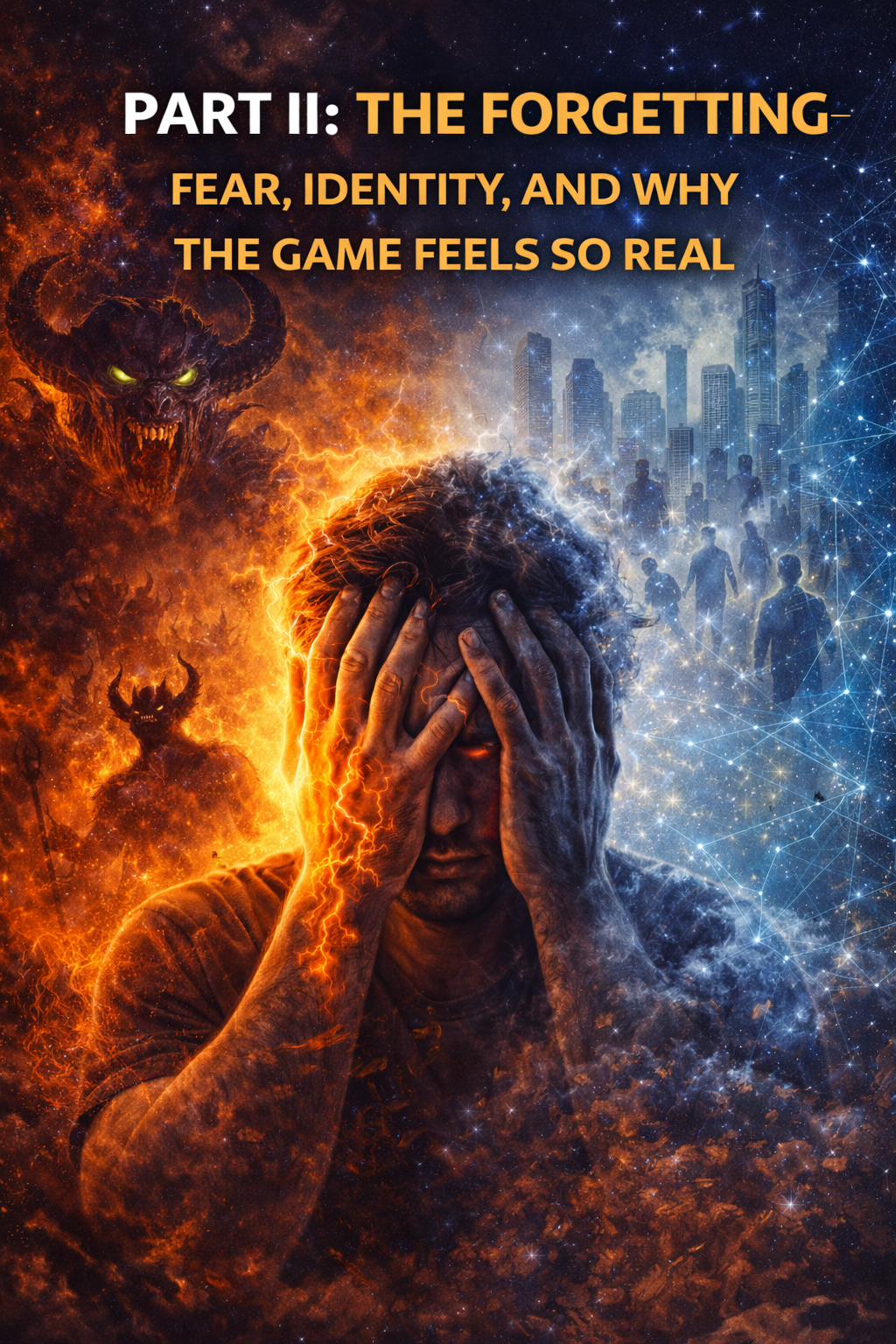
When you chose to incarnate here, you didn’t just forget who you are—you forgot that you chose to forget. That second layer is what makes this realm feel so convincing, so immersive, so real.
If you remembered everything immediately, the game would collapse. Contrast would vanish. Choice would lose meaning. Experience would flatten.
So forgetting deepened.
Fear Is the Engine, Not the Enemy
Fear is not a flaw in humanity.
Fear is the mechanism that sustains the game once forgetting sets in.
When a being forgets its connection to Source, the first sensation that arises is vulnerability. From vulnerability comes fear. From fear comes the instinct to protect, to secure, to control.
Control is not born from cruelty.
It is born from uncertainty.
The moment you believe you are separate, you begin to guard resources, identities, and outcomes. The world narrows. Lines are drawn. Rules harden.
This is how fear becomes systemic—not because of evil intent, but because fear seeks stability.
Identity Is the Mask That Makes Forgetting Stick
To forget fully, you need a mask.
Identity provides it.
“I am my name.”
“I am my job.”
“I am my history.”
“I am my trauma.”
“I am my beliefs.”
Identity is not wrong—it is functional. It allows the game to be played with depth and intensity. It creates stakes. It gives the illusion weight.
But identity becomes a prison when it is mistaken for truth.
You are not your story.
You are the awareness experiencing it.
The tighter the identification, the harder it becomes to remember.
Control Tightened as Love Was Forgotten
As humanity drifted further from unconditional love, creation slowed and narrowed.
Not because reality punished us—but because fear fractured coherence.
When fear dominates:
- Energy becomes currency instead of flow
- Land becomes property instead of stewardship
- Food becomes leverage instead of nourishment
Rules multiply. Access narrows. Systems emerge to preserve advantage across time.
This is not conspiracy—it is inevitable psychology.
Groups that forgot themselves attempted to stabilize the game in their favor. Not because they were monsters, but because fear convinced them survival required dominance.
And once systems are in place, they perpetuate themselves.
But remember this:
No system is stronger than remembrance.
Greed Is Fear Wearing a Crown
What we label as greed is fear trying to outrun itself.
Accumulation is an attempt to silence uncertainty.
Control is an attempt to escape impermanence.
Those who appear most powerful are often the most afraid—because power built on fear requires constant defense.
This is why demonizing “them” misses the point.
There is no “them.”
There is only humanity exploring forgetting at different depths.
The further one strays from love, the more control feels necessary.
Why the Game Feels So Heavy Right Now
We are in a phase where forgetting has reached saturation.
The systems built to control the game are straining under their own weight. Not because they are being attacked—but because they are no longer aligned with remembrance.
When enough players remember:
- Old rules stop making sense
- Authority loses its mystique
- Fear loses its leverage
The game doesn’t end.
It evolves.
The Quiet Beginning of Remembrance
Remembrance does not arrive as spectacle.
It arrives as:
- A moment of stillness
- A sudden compassion for someone you once judged
- A realization that you don’t need to win
- A soft knowing that you are safe even without control
This is not awakening as performance.
This is awakening as relaxation.
The mask loosens. The grip softens. The game becomes playable again.
A Simple Reminder
You are not here to destroy the system.
You are here to outgrow it.
As you remember who you are, creation responds. Synchrony increases. Reality bends—not dramatically, but gracefully.
You don’t break the game.
You simply stop playing it in fear.
Coming Next in Part III
The Remembering — How Play, Choice, and Love Restore Creative Flow
If this resonates, pause.
That pause is you remembering yourself.
And that—quietly—is how everything changes.