

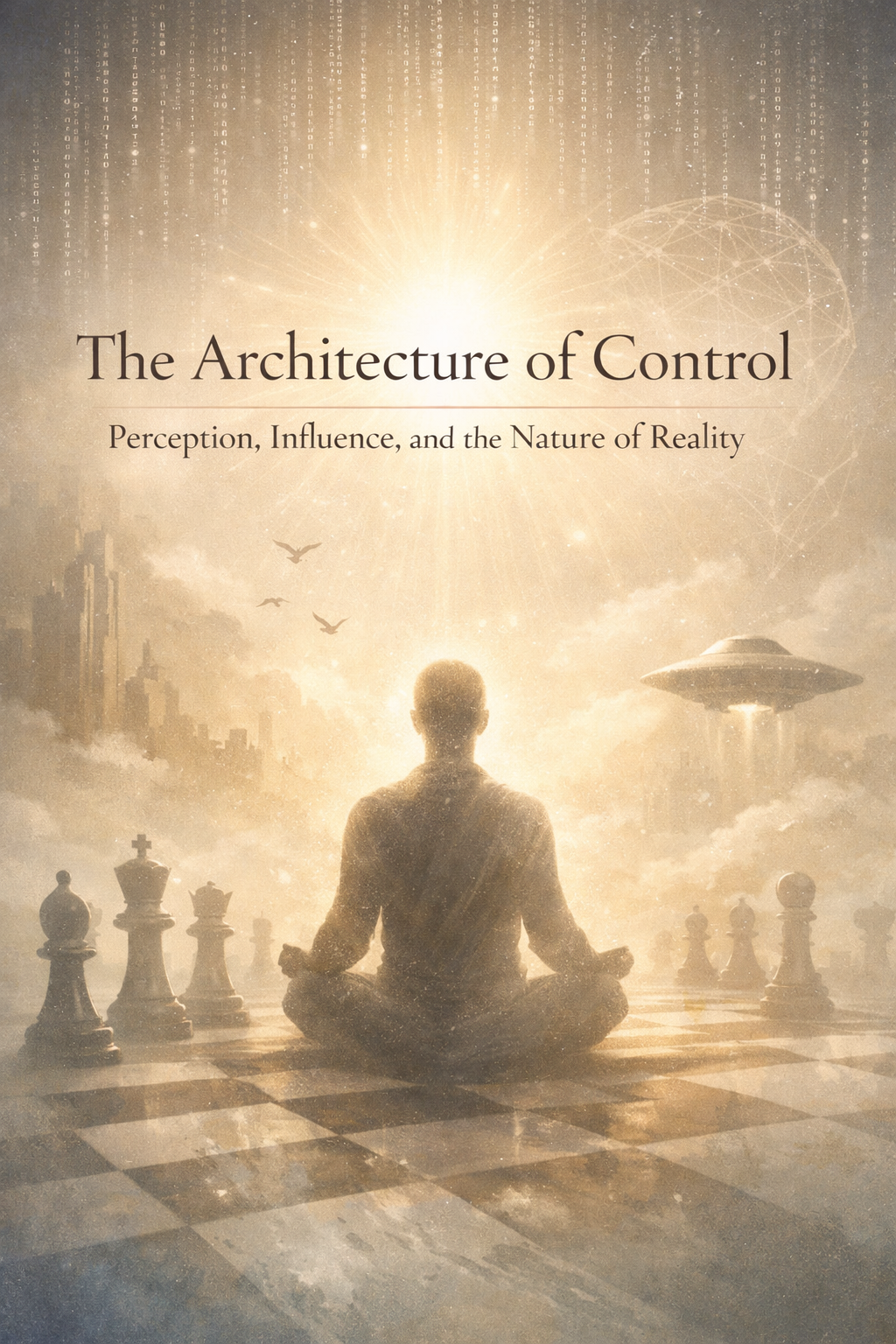
What if the greatest form of control was never force—but perception?
Not chains. Not laws. Not even fear.
But belief.
Modern society is saturated with influence. We’re nudged, steered, framed, and filtered long before we ever feel like we’ve made a “choice.” And the most effective systems of control are the ones we don’t recognize as control at all.
Influence Doesn’t Announce Itself
True manipulation is quiet. It doesn’t shout commands. It doesn’t demand obedience.
It guides attention.
What you see.
What you don’t.
What feels “normal.”
What feels unthinkable.
From advertising to politics to social media feeds, influence works by shaping emotional states and mental shortcuts. When emotion leads, logic follows—often after the decision has already been made.
This isn’t accidental. Human psychology has been studied, cataloged, tested, and refined for decades. The uncomfortable truth is that much of what we experience as “free thought” is often a reaction—not a choice.
The Legacy of Psychological Experimentation
History reveals that governments and institutions have long explored how far the human mind can be pushed, bent, or rewired. Some of these programs are now public record. Others remain obscured.
What matters isn’t just what happened—but what was learned.
The takeaway wasn’t simply how to control individuals, but how to influence groups, cultures, and belief systems at scale. Control doesn’t require compliance when it can manufacture consent.
When people believe an idea is their own, they will defend it more fiercely than if it were imposed.
Reality as a Construct
This leads to a deeper, more unsettling question:
What if reality itself is filtered?
Not in a science-fiction sense—but in a perceptual one.
Human beings do not experience objective reality. We experience interpretations—assembled by the brain from incomplete data, memory, emotion, and expectation. What we call “the world” is actually a model, continuously updated and deeply personal.
If perception can be shaped, then reality—at least as we experience it—can be shaped too.
This opens the door to ideas that feel fringe until you sit with them long enough:
- Is consciousness fundamental?
- Is reality participatory?
- Are we observers, or co-creators?
Fear Is the Weakest Lever
One of the most revealing insights is that fear is actually a crude tool. It works—but only temporarily.
The most powerful influence operates through identity.
If you can convince someone who they are, you no longer need to control what they do.
Beliefs become self-reinforcing loops:
“I am this kind of person.”
“People like me think this way.”
“This is how the world works.”
At that point, the system runs itself.
Awakening Isn’t Rebellion—It’s Recognition
True awakening doesn’t require fighting the system.
It requires seeing it.
Awareness dissolves unconscious influence. The moment you recognize a manipulation, it loses much of its power. The moment you question a belief, it becomes optional.
This doesn’t mean rejecting everything or descending into paranoia. It means reclaiming discernment. Slowing down. Observing your own reactions. Asking:
- Why does this trigger me?
- Who benefits if I believe this?
- Is this my conclusion—or one I inherited?
The Way Out Is Inward
The paradox is that the more external control tightens, the more internal freedom becomes available.
No institution can govern awareness.
No narrative can survive scrutiny.
No illusion holds once it’s recognized as one.
Clarity doesn’t come from knowing more facts—it comes from seeing how meaning is assigned.
And in that seeing, something profound happens:
You remember that you are not a pawn inside reality.
You are a participant in its creation.